Electron Microscopy Sciences

View Cart || Request a Catalog
New for 2007

curve curvel

Scanning Electron Microscope Supplies

Electron Microscopy Sciences

arrow14 SPM, AFM, SEM Calibration Standards

arrow12Magnification Reference Standards - SPM, AFM, SEM Calibration Standards

EMS offers a series of calibration standards with one and two dimension calibrated patterns. The standards come in two grid spacings – 300 nanometers and 700 nanometers. These standards
are created utilizing holographic interference of a particular laser frequency. They are typically accurate to <1% across the entire surface of the standard.


SPM, AFM, SEM Calibration Standards SPM, AFM, SEM Calibration Standards

White area material: Tungsten.
Black area material: Tungsten, or other metal.

Materials:
The calibration specimen consists of a silicon chip with a thin (100nm) thick polymer layer containing the pattern and a thin tungsten film over-coating the entire surface. The tungsten film varies from 20nm to 60nm in thicknenss, depending on the particular model. This structure has been proven under a wide varitey of beam conditions,
from 30kV to sub 12 kV.

Dimensions:
300nm or 700nm nominal (exact dimension will be provided with sample). Measurements are made from leading edge to leading edge, etc. Width of individual bars and spaces is not calibrated.

Background

EMS MXS "CE" and "BE" series SEM magnification reference gratings and grids set new standards for sub-micron accuracy and ease-of-use. Designed to meet the requirements for a reasonable cost, accurate sub-micron reference standard, "CE" Series Reference Standards can be tailored to meet a variety of needs.

These reference standards are remarkably durable under typical operating conditions. The surface contamination behavior is also very good. There are no better sub-micron reference standard available in this price range.

One test site indicated that on a scale of 1 to 5 with respect to ease of use, contrast/brightnes, durability, and accuracy, "CE" series reference standards earn a 4.7 out of 5 average in comparison to other available standards. Comments from various other test sites included "very good contrast/brightness levels at all voltages used," "easy to use," and "could become my secondary standard of choice."

Application

EMS's MXS "CE" series reference standards provide a calibrated dimension of either 300 nm or 700 nm nominal length. ("BE" series available only 300 nm)

Throughout this magnification range, these standards provide excellent image contrast, an enormous useful calibration area, and a 3-sigma accuracy of at worst 3%, with typical values around 1%.

MXS "CE" and "BE" series reference standards are available as unmounted 3 mm x 4 mm pieces to be mounted by the microscopist, or pre-mounted for easy insertion in your SEM. Mounting one of these calibration standards is striaghtforward. The front surface of the sample and the silicon substrate are conductive. Experience indicates that there is, in general, no need to make a special effort to ground the front surface. The use of conductive silver or carbon-loaded paint, conductive epoxies, conductive tape, etc. have all been used to successfully mount "CE" Series standards.

SEM magnification reference gratings and gridsWith EMS's MXS "CE" and "BE" Series Reference Standards, you can:

The accuracy of the "CE" Series Reference Standards, allows the microscopist to use them as a secondary standard. Their accuracy and uniformity make it easy to obtain and document traceability of measurements without placing an expensive, hard to obtain, difficult to use primary calibration standard at risk of contamination or damage.

Certification and Accuracy

MXS "CE" Series Reference Standards provide a calibrated dimension of either 300 nm or 700 nm nominal length. The actual dimension of the artifact as delivered will generally not be exactly these values. Both the fabrication process determines the actual dimension and by a second, independent measurement after the calibration artifact is manufactured.

The expected accuracy of the holographic technique used in the manufacturing process is ±0.1%. Unfortunately, subsequent processing steps degarde this initial accuracy, leading to the 3-sigma accuracy of 3% for the finished product. The second, independent measurement technique has an expected 3-sigma accuracy of 1% or better. Our experience is that the two measurement techniques applied to a particular artifact will agree with each other within 0.5mm.

It is important to remember that the certified dimension in an MXS "CE" and "BE" Series Reference Standard is not just at one unique position on the artifact, but is known at all locations on the standard.

Durability and Charging Effects

EMS MXS "CE" and "BE" Series Reference Standards have been tested and evaluated over a broad range of operating conditions, from those found in a tungsten filament system to the highest resolution FEG system. These standards have been found remarkably durable during use, with no beam-induced distortion in the calibrated pattern after as much as one-half hour of imaging time at 50,000X and 20 KV. Charging is minimal to non-existent, though edge-effect can be seen under some conditions. The high contrast and brightness, which can be obtained using these reference standards guarantees good contamination tolerance.

arrow121. MXS 301CE and MXS 701CE

The calibrated dimension is the spatial period of a series of parallel ribs running across the surface of the sample. The significant height of the ribs (>100 nm) provides excellent image contrast. The top surface of the rib structures is somewhat rounded rather than completely flat. The edges of the ribs are readily discernible, with over 75% of the 3 mm by 4 mm sample area exhibiting an edge location variation, which is less.

Use and Imaging

The exceptionally clean and uniform pattern provided in an MXS 301CE or MXS 701CE standard displays few imperfections, which can be used as focusing and stigmation aids. For this reason, care in setting up the image before measurement is important. To assist in the setup process, an instruction sheet is provided with each standard. This sheet provides several example images, which can be used to determine if the image of the sample is correctly set up. Expecially with the MXS 301CE and MXS 701CE line-space pattern standards, obtaining the proper stigmation is crucial since improper stigmation is not readily apparent when imaging a pattern of straight line. Once a proper focus and sigmation are obtained, the image can be shifted to an appropriate area and the desired measurements made.

arrow122. MXS 302CE and MXS 702CE

The calibrated dimension is the spatial period of a series of a 2-dimensional grid spread across the surface of the sample. This grid consists of a series of cylindrical posts rising from the surface of the sample. The significant height of the ribs (>100 nm) provides excellent image contrast. The top surface of these posts is somewhat rounded rather than flat and there are also slight departures from a perfect circle in the shape of some posts. Measurement techniques must be used which take these characteristics into account. The center-to-center distance of any pair is the most accurate measurements.

Use and Imaging

The exceptionally clean and uniform pattern provided in an MXS "CE" series 2-dimensional calibration standard displays few large scale imperfections which can be used as focusing and stigmation aids. For this reason, taking care in setting up the image before measurement is important. To assist in this process, an instruction sheet is provided with each standard. This sheet provides several example images which can be used to determine if the image of the sample is correctly set up.

The characteristics of the MXS 302CE and MXS 702CE standards make them easier to image than the 1-dimensional standards. The 2-dimensional grid facilitates setting the stigmation of the image properly. Once proper focus and sigmation are obtained, the image can be shifted to an appropriate area and the desired measurements made.Since the pattern covers the entire sample area, it is possible to make over 1,000,000 measurements utilizing the standard without using the same area twice.

Cleaning for the CE Series

Cleaning is possible using dry air or other clean gases, high purity distilled or deionized water, and soft brushes. Rubbing with soft tissues, or any other firm physical contact, or the use of solvents such as acetone or alcohol will damage the surface of the reference standard.

arrow123. MXS 301BE

The calibrated dimension is the spatial period of alternating lines of Titanium and Silicon. The use of two different elements provides excellent image contrast, and the titanium layer thickness is kept to 20 nm to control edge distortion effects in the SEM image. These physical characteristics make the edges sharp and readily discernable. The calibrated pattern covers the entire sample, providing over 1,000,000 measurement sites. Because the pattern is a direct recording of a laser-generated interference pattern which has been transferred into the 20 nm thick Titanium film, these calibration samples are the most accurate available.

Imaging and Application

The exceptionally clean and uniform pattern provided in a MOXTEX MXS "BE" series calibration standard displays few imperfections which can be used as focusing and stigmation aids. For this reason, care in setting up the image before measurement is important. To assist in this process, an instruction sheet is provided with each standard. This sheet provides several example images which can be used to determine if the image of the sample is correct. Once a proper focus and stigmation are obtained, the image can be shifted to an appropriate area and the desired measurements made.

The full screen image provided by a MOXTEX calibration sample provides a unique advantage. Most calibration standards really verify accuracy of one portion of the image, while the entire screen is part of the measurement tool. With an image that fills the screen, you can quickly diagnose all types of image distortions, including problems due to vibrations, external fields, etc. A common problem is distortion caused by missadjusted CRT's or scanners in which the magnification in one part of the image is different from another part of the image. Such problems are easily found and corrected using these calibration samples.

Cleaning for the BE Series

Titanium on Silicon produces a very durable calibration pattern. The calibration standard can be cleaned using common solvents such as acetone or alcohol, detergents, deionized water, etc. Gentle physical rubbing with soft tissues, brushes, etc., should not damage the sample. In extreme cases, cleaning by oxygen plasma may be possible.

Product Data

  301CE & 701CE 302CE & 702CE 301BE**
Substrate
Silicon Wafer Silicon Wafer Silicon Wafer
Top Surface
60 nm Tungsten film 60 nm Tungsten film Ti pattern on Si
Physical Size
3mm x 4mm x 0.5mm 3mm x 4mm x 0.5mm 3mm x 4mm x 0.5mm
Accuracy
± 3% ± 3% ± 1%
Nominal Dimensions
(x) (x, y) (x)
300 nm for 301CE 300 nm for 302CE 300 nm for 301BE
700 nm for 701CE 700 nm for 702CE  
Availability
mounted or unmounted* mounted or unmounted* mounted or unmounted*
*The cost for mounted samples using standard aluminum pin type stubs (EMS #75200). Please call us for additional expense.
**MXS-301BE Calibration sheet provided with standard contains actual dimensions to 3 significant figures. NPL tracability is also available with an additional cost.
Appli-cation Product Pattern Material Nominal Pitch Mounting Product No. Price Cart
SEM 701CE Parallel Ridges W-coated Photoresist on Si 700 nm unmounted 80110-71 318.00 cart
      mounted 80110-71M 418.00 cart
SEM 301CE Parallel Ridges W-coated Photoresist on Si 300 nm unmounted 80110-31 424.00 cart
      mounted 80110-31M 524.00 cart
SEM 702CE Array of Posts W-coated Photoresist on Si 700 nm unmounted 80110-72 636.00 cart
      mounted 80110-72M 736.00 cart
SEM 302CE Array of Posts W-coated Photoresist on Si 300 nm unmounted 80110-32 848.00 cart
      mounted 80110-32M 948.00 cart
AFM, SEM, TOF-SIMS, Auger, etc. 301BE Parallel Ridges Ti lines on silica 300 nm unmounted 80111-31 1,060.00 cart
    mounted 80111-31M 1,160.00 cart

Special Services (Needs to be added to the standard price)

SS-301 301BE Certification   2,650.00 cart
SS-SEM Mount Certified Specimen for SEM   212.00 cart

SPM measurements using SPM Calibratorarrow12SPM CALIBRATOR

Improve the accuracy of your SPM measurements using SPM Calibrator, the new standard for image accuracy.

The Problem:

Effective process controls depends on accurate dimensional measurements. Quality assurance requires fast, thorough calibration checks.

The Solution:

SPM Calibrator is a new system for calibrating scanning probe microscopes. It can help you improve the accuracy of critical dimension measurements and makes QC testing of your SPM easier.

Ordinary SPM scans may be accurate only to 5%. This can make it hard to judge whether device dimensions actually meet specifications.

SPM Calibrator consists of a reference standard and data analysis software. The output shows you how accurate your SPM is. Every SPM user benefits from the convenience of well documented calibration checks. You can improve the accuracy of your existing SPM, guided by the results from SPM Calibrator.

WHY SETTLE FOR 5% ACCURACY WHEN YOU CAN HAVE 0.5%?

Product Description

Overall Benefits:

Features and Benifits:

Description:

The 1-D standards can be scanned using any AFM mode, including contact mode. The 2-D standards can be scanned using modes such as Tapping Mode™, intermittent contact, and non-contact.

Calibration Reference Specimen for AFM and STMRecent Additions:
arrow12Model 150-1D

Accurate measurements of sub 0.5 micron features are increasingly important as nanotechnology develops and as conventional microfabricated structures (semiconductors, magnetic data storage devices, optical data discs) shrinking. The model 150-1D with a nominal period (pitch) of 150nm, one dimensional, fabricated on a transparent substrate (Aluminum lines on glass) is the new tool to support this work.

Calibration Reference Specimen for AFM and STMarrow12Model 750-HD

High Durability Calibration Reference Specimen for AFM and STM

Each specimen is supplied with a calibration certificate.Can be used for ATM, STM and SEM. Has been used successfully in a hot water AFM.

Nominal pattern dimensions: Pitch 750 nm
  Height 100 nm
Nominal specimen dimensions: 6.35 mm diameter, 0.3 mm thick
Composition: Solid Nickel

Phase Imaging Test Specimen arrow12Model PT

Phase Imaging Test Specimen (verify TappingMode™ phase contrast and resolution).

Phase Imaging is a sharp probe, which is brought into proximity with the specimen surface. The probe is oscillated vertically near its mechanical resonance frequency. As the probe lightly taps the surface the amplitude of oscillation is reduced and the AFM uses this change in amplitude in order to track the surface topography. In addition to its amplitude, the probe motion can be characterized by its phase relative to a driving oscillator. The phase signal changes when the probe encounters regions of different composition. Phase shifts are registered as bright and dark regions in phase images, comparable to the way height changes are indicated in height images.

Phase images often show extraordinary contrast for many composite surfaces of technological and scientific interest. These include contamination deposits, discontinuous (i.e. defective) thin films devices built of composite materials (e.g. magnetic recording heads), and cross-sectional specimens of composite materials. Both inorganic and organic materials can be examined. We have found that phase imaging is more convenient and gentler than other methods, which are based on contact mode operation. It routinely achieves lateral resolution of 10 nm.

References

1.Pereira, D.E.D. & Claudio-da-Silva, Jr., E. "Improvement of AFM as an analytical Instrument for Residual Lignin Characterization" in: Proceedings International Symposium on Wood and Pulping Chemistry, Helsinki, Finland, June 1995.

2.Pereira, D.E.D., Chernoff. D., & Claudio-da-Silva, Jr.,E., & Cemuner, B.J„ "The use of AFM to investigate the delignificalion process: Part 1-AFM performance by differentiating pulping processes", to be published.

Ordering for Calibrator only

Product No. Appli-cation Product Pattern Material Nominal Pitch Mounting Price Cart
80122-1D AFM 700-1D Parallel ridges W-coated Photoresist on Si 700 nm 15mm steel disk 371.00 cart
80123-1D AFM 300-1D Parallel ridges W-coated Photoresist on Si 300 nm 15mm steel disk 477.00 cart
80122-2D AFM 700-2D Array of posts W-coated Photoresist on Si 700 nm 15mm steel disk 742.00 cart
80123-2D AFM 300-2D Array of posts W-coated Photoresist on Si 300 nm 15mm steel disk 954.00 cart
80124-HD AFM, SEM 750-HD Array of Flat Bumps Ni 750(X), Z(100) un-mounted 265.00 cart
80124-EDU AFM, SEM 302-EDU Array of Posts W-coated Photoresist on Si 300 nm un-mounted 371.00 cart
80124-PT AFM Phase Imaging PT Random hard & soft domain as small as 10nm Polymer None 15 mm steel Disk 159.00 cart
80125-1D AFM, SEM, TOF-SIMS, Auger, etc. 150-1D Parallel ridge A1 Lines on Glass 150 un-mounted 583.00 cart


SEM High Magnification

The following image was captured with
a magnification setting of 100kX and
accelerating voltage 10 kV

Traceable Standard for Resolution Calibration AFM, SEM, Auger, and FIB

AFM Tapping Mode Scan

AFM Tapping Mode Scan

The bump height is about 90 nm. This specimen is not recommended as a height reference because it is not easy for the standard AFM probes to reach the substrate level between the pumps.

SEM Medium Magnification

SEM Medium Magnification

At 5 kX, the individual bumps were still well resolved. Large fields of view show how few defects are present.

The most common defects are single missing bumps or a single extra bump inserted between lattice positions. Two vacancies are present in the image shown here.

arrow12Model 150-2D — Very High Reference and Traceable Standard for Resolution Calibration AFM, SEM, Auger, and FIB

General Purpose – High Precision

A precision, holographic pattern provides accurate calibration in the horizontal plane for very high resolution, nanometer-scale measurements.

Period: 144 nm pitch, two-dimensional array. Accurate to ± 1 nm. Refer to calibration certificate for actual pitch.

Surface: Aluminum bumps on Silicon, 4x3 mm die. Bump height (about 90 nm) and width (about 75 nm) are not calibrated.

For AFM, use in contact, intermittent contact (TappingMode™) and other modes with image sizes from 250 nm to 10 mm. Available un-mounted or mounted on 12 mm steel disks.

For SEM, an independent analytical lab has tested this specimen in a FE-SEM (field emission scanning electron microscope). They found that the pattern was very uniform and the specimen was easy to image. No significant charging was observed in the voltage range 1- 20 kV.

Usability: the calibrated pattern covers the entire chip. There is sufficient usable area to make tens of thousands of measurements without reusing any areas altered or contaminated by previous scans.

arrorMODEL 150-2D:

This Calibration Reference specimen comes with a nontraceable, manufacturer’s certificate. These states the average period, based on batch measurements.

arrorMODEL 150-2DUTC:

This traceable, Certified Standard is a select grade. Each standard is individually measured in comparison with a similar specimen calibrated at PTB. (PTB, Physikalisch- Technischen Bundesanstald, is the German counterpart of NIST). The uncertainty of single pitch value is typically
±1,4 nm (95% confidence interval). Multi-pitch measurements provide the usual square-root of N improvement in precision.

Easy to use

We recommended Model 150-2D because of its unique characteristics which make it especially easy to use. The specimen is durable and it allows you can scan in contact mode, offering you faster calibration and measurements. This is the only high resolution 2D calibration specimen we have seen that offers the following characteristics:

Ordering:

Model 150-2D is available either mounted on a steel disc or unmounted for AFM or Mounted or Unmounted for SEM.

80125-2D-UM High Resolution Calibration Specimen, Model 150-2D, Unmounted for AFM 1077.00 cart
80125-2D-M * High Resolution Calibration Specimen, Model 150-2D, Mounted for AFM 1077.00 cart
80125-2D-MS * High Resolution Calibration Specimen, Model 150-2D, Mounted for SEM 1077.00 cart
80126-2D-UM High Resolution Calibration Specimen, Model 150-2DUTC, Unmounted for AFM 5777.00 cart
80126-2D-M * High Resolution Calibration Specimen, Model 150-2DUTC, Mounted for AFM 5777.00 cart
80126-2D-MS * High Resolution Calibration Specimen, Model 150-2DUTC, Mounted for SEM* 5777.00 cart

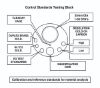
X-Checkerarrow12X-Checker

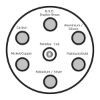
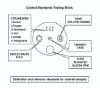
The X-Checker was the first and remains the only complete calibration aid for SEM/EDS Systems. When time is short but you want to know how well your system is performing you need the X-Checker. Each X-Checker comes with the following:

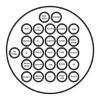
You also get two grid sizes for checking the accuracy of your image analysis software and an easy test for monitoring the amount of vacuum pump oil contamination on your detector window.

80058-ST X-Checker, Standard each 300.00 cart
80058-BN X-Checker, With Boron each 400.00 cart
80058-EX X-Checker, Extra each 400.00 cart
logo22 About Us | Product Index | Privacy Policy | Contact Us | ©2003-2007 Electron Microscopy Sciences