Questions? 800-523-5874 | [email protected]
- TEM Grids
- Prepmaster™ Specimen Preparation Robot
- TEM Window Grids
- Omniprobe Nanomanipulation Systems
- K-kit Wet "Liquid" TEM Kit
- Specimen Mounts
- SEM Specimen Holders
- Index and Finder SEM Grids
- SEM for Forensics
- SEM Sample Preparation Station Materials
- Cryogenic Personal Protection Equipment
- Cryo Dewars & Flasks
- Cryo-EM Grids & Grid Storage
- Cryogenic Vials & Racks
- Cryo-EM Vitrification Supplies
- Prepmaster™ Specimen Preparation Robot
- Laboratory Microwave Ovens
- LYNX II Automated Tissue Processor
- EMS Poly III
- Microtomes
- Tissue Slicers
- Heaters & Chillers
- SEM Cooling Stage
- Glow Discharge Systems
- Sputter Coaters & Carbon Coaters
- Stages
- Freeze Dryers
- Critical Point Dryers
- Cryo-SEM Preparation System
- Specimen Transfer Systems
- Decontaminators
- Desiccators
- Centrifuges
- Dry Baths
- Stirrers, Hot Plates
- Vortexers & Magnetic Mixers
- Rotators & Rockers
- Ovens & Incubators
- Vibration Isolation
- Air Sampling
- Vacuum Pumps
NIGHTSEA® Fluorescence Viewing Systems

NIGHTSEA Stereo Microscope Fluorescence Adapter
Adapt your existing lab stereo microscopes for fluorescence
The NIGHTSEA Stereo Microscope Fluorescence Adapter adapts just about any stereo microscope (dissecting microscope) for fluorescence with no modification to the microscope itself. The modular design lets you easily switch between several different excitation/emission combinations to work with a variety of fluorescent proteins and other fluorophores. There are now six different excitation/emission combinations available, plus white light.
Product Notice August 2026
Up to now we have offered what we call the ‘standard’ base with simple on/off operation, and a separate intensity control option, which we called DIM. As of August 2026 all systems will include the intensity control feature.
The intensity control does not degrade performance compared to the on/off switch. When first energized the unit comes on at the same full power level, while further rotation of the rotary knob reduces the intensity to about 30% of maximum.
Why would you want to reduce the excitation intensity, given that usually you want as much fluorescence response as you can get? There are situations for which it can be beneficial to reduce the excitation, and you can read about them in this article.
Applications
This simple system is excellent for
- Quick screening of your fluorescent genotypes -Drosophila, zebrafish, C. elegans,...
- Genotype sorting
- Fluorescence-aided dissection, injection, or micromanipulation
- Pre-screening sample preps for confocal or other high-resolution imaging
- Freeing up your research-grade fluorescence microscopes for more demanding work
- New faculty start-up budgets
- Bringing fluorescence into the teaching laboratory
- Coating and failure analysis, circuit board work, defect location, food safety, paper analysis, and more
Fluorescence isn't just for research microscopes anymore...
- Now sort on your laboratory-level stereos
- Use to facilitate micromanipulation and dissection
- Expand from your research lab to your classroom
Modular...
- Installs in seconds - just clicks into place
- Interchangeable excitation/emission combinations
- Move from microscope to microscope
- No modification to your microscope needed
Economical - More Glow for the Dough...
- Stretch your lab budget
- Inexpensive enough for classroom use
Grows as your lab grows...
- Buy just what you need now (up to 6 different wavelength sets)
- Add more as your needs expand
The Stereo Microscope Fluorescence Adapter system consists of
- Flexible gooseneck lamp base with power supply
- Light head
- Ring adapter for microscope (also available for Leica EZ4 series)
- Barrier filter
- Filter shield
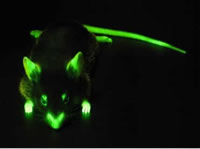
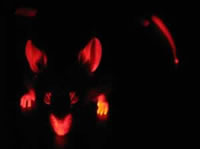
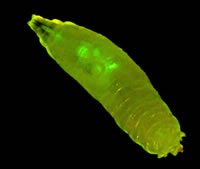
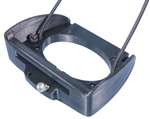
The light head, barrier filter, and filter shield are interchangeable so that you can easily switch between excitation/emission light+filter combinations.
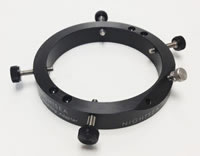
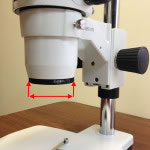
The microscope mounting adapter fits up to 67mm to work with the majority of stereo microscopes. An oversize adapter and an adapter for the Leica EZ4 series are also available.
Once you are set up for one excitation/ emission wavelength combination, additional combinations can be added by purchasing a kit that consists of a light head, barrier filter, and viewing shield. These three elements can be removed and replaced in seconds, and color coding ensures that you are using the right combination. The barrier filter clicks on to the ring adapter magnetically, so it is easy to remove it to switch back to white light viewing.
Wavelength Sets
For more in-depth information on excitations, see this Technical Data Sheet
| Designation | Excitation | Emission | Fluorophores |
| UV – Ultra Violet | 360-380nm | 415nm LP | DAPI, ... |
| VI – Violet | 400-415nm | 450nm LP | CFP, ... |
| RB – Royal Blue | 440-460nm | 500nm LP | GFP, eGFP, fluorescein... |
| RB-GO – Green Only | 440-460nm | 500-560nm BP | GFP, eGFP, fluorescein... |
| CY – Cyan | 490-515nm | 550nm LP | YFP, Venus, Lucifer Yellow... |
| GR – Green | 510-540nm | 600nm LP | DsRed, dTomato... |
Green-Only Barrier Filter
The Green-Only (GO) Barrier Filter isolates the green part of the spectrum and is for use with the Royal Blue excitation source. While our other barrier filters are longpass filters this filter is a bandpass, transmitting from approximately 500 to 560nm. The longpass filter has served well for most users who need to visualize green-fluorescent protein (GFP), and if you are exploring fluorescence in nature it is preferable. The primary motivation for adding the green-only filter to the line-up was for the benefit of researchers using GFP in plants such as Arabidopsis thaliana, a common research model. Plants contain chlorophyll, which has a distinctive red fluorescence that can sometimes mask the GFP emission, making it harder to see and photograph.
Microscope Mounting Adapter - standard size fits up to 67mm. Also available for oversize (up to 84mm) and Leica EZ4 Series.
NIGHTSEA Product Line - Additional Information
Fluorescence for Education and Outreach
NIGHTSEA Brochure (PDF)
Mazel, C., 2013. Adding Fluorescence to Stereo Microscopes. Microscopy Today, 21(5): 12-17. (PDF)
- Application: Crack and Failure Analysis with Fluorescence
- Insect Fluorescence in the Wild
- A STEM Outreach – BrainFest
- A Spectral Mystery – Solved!
- NIGHTSEA® Violet Light Head Photoconverts CaMPARI
- Does it Fluoresce – Dryer Lint
- NIGHTSEA® SFA with Unitron and Zeiss Microscopes
- Pervasive Microplastics
- Forensic Sciences and Fluorescence with the NIGHTSEA® SFA
- Selecting and Dissecting GFP Mouse Embryos
- Fluorescence-Aided Dissection of GFP-Labeled Structures
- Sorting Genotypes: Drosophila Larvae
- Sorting Genotypes: Arabidopsis Seeds
- Pre-Screening Samples for Fluorescence
- Focus Stacking for Improved Depth of Field
- Coral Recruitment through the Microscope
- Fluorescence for Coral Recruitment Research
- Fluorescent Zebrafish
- Fluorescent Xenopus
- Fluorescent C. elegans
- Fluorescent Axolotl
- Green-Only Barrier Filter for the SFA
- Green Fluorescence – Longpass vs. Bandpass Barrier Filter
- Checking Fluorescence of Bacterial or Cell Cultures
- Microplastics and Fluorescence
- Defect Detection in Nylon Granules
- Will The Stereo Microscope Fluorescence Adapter Fit My Microscope?
- True Ultraviolet Excitation/Emission for the SFA
- SFA vs. High-End Systems for Stereo Fluorescence Microscopy
- Research and Educational Institutions Using NIGHTSEA®
- Publications Citing Use of NIGHTSEA® Equipment
- Application: Genetics Laboratory Experiment Using NIGHTSEA®
- Application: Screening FISH-Labeled Planaria (Schmidtea mediterranea)
- Sodalite Fluorescence – a Viral Sensation
- Concrete Thin Section Fluorescence
- Coral Reef Restoration at Mote Marine Laboratory
- The Jellyfish that Won the Nobel Prize
- Tetracycline Fluorescence to Visualize Active Drug Distribution in Tablets
- Microfiber Fluorescence
Citations
Aitken, J., V. Ramnath, V. Feygels, A. Mathur, M. Kim, J. Y. Park, and G. Tuell, 2010. Prelude to CZMIL: seafloor imaging and classification results achieved with CHARTS and the rapid environmental assessment (REA) processor. Proc. SPIE 7695, Algorithms and Technologies for Multispectral, Hyperspectral, and Ultraspectral Imagery XVI.
Anastasio, N. C., et al., 2013. Functional status of the serotonin 5-HT2C receptor (5-HT2CR) drives interlocked phenotypes that precipitate relapse-like behaviors in cocaine dependence. Neuropsychopharmacology (13 August 2013). doi:10.1038/npp.2013.199.
Baillie, L. D., V. Hagen, K,. M. Gardner, and S. J. Mulligan, 2011. Functional imaging within individual pain fibres ex vivo with optical microscopy. Journal of Neuroscience Methods, 198(2): 274-279....more citations